
The Missing Ingredient: Why Trinidad & Tobago Needs Its Own Dietary Guidelines in 2026 (And 9 Things They Must Include)
It is 2026. We have the culture, the crops, and the culinary talent. So why are we still relying on outdated or generic Caribbean food groups? As NCDs rise and food prices fluctuate, T&T needs a specific, official National Dietary Guideline. This isn't just a wish list, it's a roadmap for a healthier Republic. Here are the 9 pillars that should define our national plate.
CARIBBEAN LIVING AND LIFESTYLEPUBLIC HEALTH AND NUTRITION POLICY
Iola Prieto
1/7/20268 min read
A National Recipe Without a Cookbook
If you were to search for the "Official Dietary Guidelines of Trinidad and Tobago" today, you might find yourself in a loop of broken links, generic Caribbean charts from decades ago, or pamphlets from the USDA. While our Ministry of Health and the Nutrition and Metabolism Division have done commendable work with initiatives like TT Moves and various sugar-reduction campaigns, we currently lack a singular, comprehensive, and up-to-date National Dietary Guideline document.
For a nation as developed and culturally distinct as ours, this is a gap we can no longer afford to ignore.
As we settle into 2026, the context of our food systems has changed dramatically. We are facing a "syndemic" a synergy of epidemics. On one side, we have the rising tide of Non-Communicable Diseases (NCDs) like diabetes and hypertension, which account for the vast majority of deaths in our country. On the other, we face the economic realities of food inflation and the climate imperative to eat what we grow.
We cannot continue to rely on the "Caribbean Six Food Groups" of the 1990s. We certainly cannot rely on American food pyramids that prioritize wheat and dairy in ways that don't match our biology or our landscape. We need a manifesto that speaks to us. We need guidelines that understand that a "light snack" in Trinidad is often a doubles with slight pepper, and that "staying hydrated" involves navigating a sea of sugary fruit punches.
This article is a respectful but urgent call to action for our policymakers, nutritionists, and stakeholders. It is time to formalize a nutrition doctrine for the Republic.
Here are the 9 pillars I would love to see in the inaugural 2026 Dietary Guidelines for Trinbagonians.
1. The "Climate Resilient" Plate: Provisions over Processed Wheat
For decades, dietary advice has lumped all carbohydrates into one massive "Staples" group. In this model, a slice of white bread is nutritionally equivalent to a serving of dasheen. In 2026, our guidelines must shatter this equivalence.
The Context: Trinidad and Tobago imports a staggering amount of wheat. Not only does this drain our foreign exchange, but it also leaves our food security vulnerable to global wars and shipping crises. Furthermore, refined wheat flour found in our hops, roti skins, and pastries spikes blood sugar rapidly, contributing significantly to our diabetes crisis.
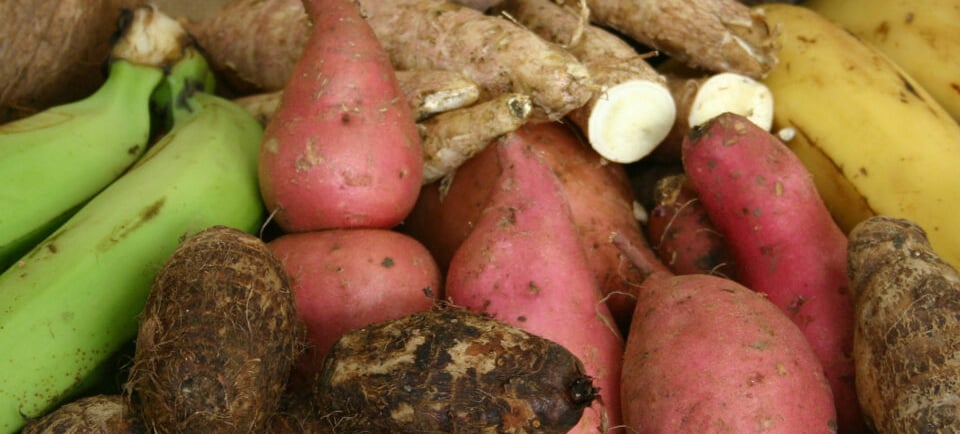
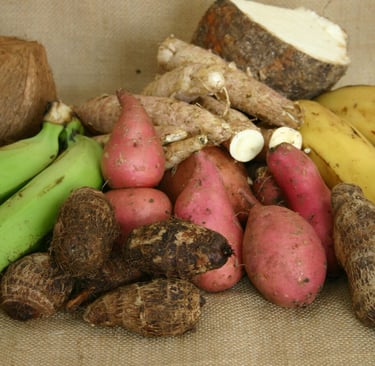
The Proposal: The new guidelines should explicitly prioritize climate resilient, locally grown root crops (ground provisions) over imported refined grains. We need to stop calling them "blue food" and start calling them "superfoods."
The Science: Root crops like sweet potato, white dasheen, and eddoes are complex carbohydrates with lower glycemic indices than white flour. They are rich in resistant starch, which feeds healthy gut bacteria.
The Policy Push: The guidelines should recommend a "4-to-1" ratio: for every meal with wheat, aim for four meals with provisions, green figs, or breadfruit.
Cultural Application: This isn't about banning roti. It's about promoting innovation like sweet potato flour dumplings or breadfruit pie as the new standard for Sunday lunch.
Why this matters: Aligning our diet with our agriculture is the only way to ensure long-term food security.
2. A "Trini-Specific" Visual Guide (Retiring the Pie Chart)
If you show a Trini grandmother a pie chart divided into four separate sections Protein, Grains, Veg, Fruit she might nod politely, but she won't cook that way. Our food culture is based on commingling. We eat Pelau. We eat Oil Down. We eat Curry Duck where the meat and the sauce are one.
The Context: Visual aids from the US (MyPlate) or the UK (The Eatwell Guide) assume a "meat and three veg" dinner structure. When our guidelines fail to reflect our cooking style, the population ignores them.
The Proposal: I propose the "Calabash Guide" or the "Steelpan Pot" Visual.
The Visual: Imagine a graphic of a traditional iron pot or a calabash bowl.
The Lesson: Show how to proportion a mixed meal.
The Base: Instead of the pot being 80% rice, the visual shows a pot that is 50% bulky vegetables (pumpkin, bodi, carrots, melongene), 25% legumes (pigeon peas/lentils), and 25% starch (rice/provision).
The "Roti" Rule: We need a specific visual for roti. One "bus-up-shut" skin can be equal to 6 slices of bread. The guidelines must visually demonstrate that the "skin" is the carb source, so you don't need to add a side of potato or rice inside the roti.
3. The "Sweet Drink" State of Emergency
We need to have a hard conversation about what we drink. In T&T, "juice" is a love language. If you visit someone’s house, you are offered a glass of something cold and sweet.
The Context: The World Health Organization (WHO) recommends limiting free sugars to less than 10% of total energy intake (ideally 5%). In Trinidad, a single bottled soda or a "box juice" often contains more than an entire day's allowance of sugar. We are drinking our diabetes.
The Proposal: The 2026 Guidelines must declare a "State of Emergency" on liquid sugar. This cannot be a soft suggestion; it must be a hard line.
Redefining "Juice": The guidelines must explicitly distinguish between fruit (fiber included) and fruit drinks (sugar water). It should advocate for eating the orange, not drinking the juice.
The "Zero-Sugar" Baseline: Water and unsweetened teas (cocoa tea, lemongrass/fever grass, orange peel tea) must be established as the default beverages for meals.
The Condensed Milk Trap: Specific advice is needed regarding our habit of adding condensed milk to "healthy" drinks like carrot juice or beetroot punch. Once you add half a tin of condensed milk, it is no longer a health drink; it is a dessert.
Resource: PAHO - Taxes on Sweetened Beverages
4. The "Sodium Assassin": Addressing Seasoning Culture
Trinbagonians have some of the best palates in the world. We love flavor. But we have confused "flavor" with "sodium."
The Context: Hypertension (high blood pressure) is the silent killer in our region. Many of us believe that if we don't sprinkle table salt on our food, we are safe. We ignore the sodium hidden in:
All-purpose seasoning salts.
Bouillon cubes (which are often the first ingredient in our pots).
Soy sauce and ketchup.
Preserved meats (saltfish, smoked bones, pigtail).
The Proposal: The guidelines must introduce a "Sodium Literacy" campaign.
Green Seasoning Supremacy: We need to return to our roots. The guidelines should champion fresh green seasoning (chadon beni, garlic, pimento, chives) as the primary flavor agent, discouraging the reliance on "packet seasoning."
The "Pigtail" Protocol: We know people won't stop eating pigtail soup or saltfish buljol. Therefore, the guidelines must provide technical instructions on how to prepare them safely, mandatory boiling and rinsing techniques to remove 80% of the sodium before cooking.
Label Reading: A dedicated section teaching Trinidadians that if a packet says "msg" or "sodium" in the first three ingredients, it is a red flag.
5. Legumes as "Mains," Not Just Sides
In a typical Sunday lunch, the stewed chicken or beef is the "star," and the pigeon peas or lentils are the "side." This hierarchy is outdated, expensive, and unhealthy.
The Context: Animal protein is becoming prohibitively expensive. Furthermore, high consumption of red and processed meats is linked to colorectal cancer. T&T has high rates of colon cancer. We have an abundance of legumes that are affordable, fiber-rich, and culturally accepted, yet we undervalue them.
The Proposal: The guidelines should position Legumes (Peas and Beans) as a primary protein source for at least 3-4 days a week.
Inflation Proof Nutrition: Frame legumes as the smart economic choice.
The "Meatless" Normalization: Encourage "Meatless Wednesdays" (or any day) not just for religious fasting, but for health maintenance.
Complete Proteins: Educate the public on food combining. Show that "Rice and Dhal" or "Corn and Beans" creates a complete protein profile that builds muscle just as well as meat, without the saturated fat.
6. The Ultra-Processed Food (UPF) Red Flag
Walk into any grocery store in T&T, and the center aisles are dominated by colorful packets of imported snacks. These are not food; they are industrial formulations designed to be addictive.
The Context: Our children are growing up in a "packet culture." Lunch kits are filled with processed cheese sticks, sugary biscuits, and sodium-laden chips. These Ultra-Processed Foods (UPFs) bypass the body’s natural satiety signals, leading to overeating and obesity.
The Proposal: The 2026 Guidelines must adopt the NOVA Classification system used by Brazil, which categorizes food by the extent of processing.
The "5-Ingredient" Rule: A simple rule for the public: If a packaged snack has more than 5 ingredients, and you can't pronounce three of them (emulsifiers, stabilizers, artificial colors), it should not be a daily part of your diet.
Fast Food Reality: We need to stop pretending Fast Food is a "treat." For many, it is a staple. The guidelines should offer "Damage Control" advice: If you must eat fast food, how to choose the least damaging options (e.g., grilled over fried, water over soda).
Reference: FAO - The NOVA Classification System
7. Smart Hydration for a Warming Climate
Climate change reports, including the Lancet Countdown, indicate that T&T will face hotter, drier dry seasons.
The Context: "Drink 8 glasses of water" is generic advice for a temperate climate. In the tropics, we sweat profusely. We lose electrolytes.
The Proposal: The guidelines must address Hydration and Electrolyte Balance.
Coconut Water (The Real Kind): Promote fresh coconut water as the national hydration drink, superior to sugary imported sports drinks. However, advise moderation (one glass a day) due to natural sugars.
Eat Your Water: In the dry season, the guidelines should encourage the consumption of high-water-content local fruits: Watermelon, Portugal, Cucumber, and Pineapple.
Heat Stroke Prevention: Specific advice for outdoor workers and schoolchildren on pre-hydrating before being in the sun.
8. The Gut-Brain Connection: Mental Health Nutrition
Mental health is a massive concern in T&T, exacerbated by crime, traffic stress, and economic pressure.
The Context: We rarely discuss the link between what we eat and how we feel. However, 95% of our serotonin (the happy hormone) is produced in the gut. A diet high in sugar and processed oils inflames the gut and has been linked to higher rates of anxiety and depression.
The Proposal: The guidelines should include a chapter on "Mood Food."
Fermented Foods: Revive the culture of homemade yogurt, fermented cucumber, or pepper sauce (naturally fermented). These are probiotics that support gut health.
Omega-3s: Highlight the mental health benefits of local oily fish like Kingfish, Carite, and Mackerel.
Fiber for Feelings: Explain that fiber (from fruit and provisions) regulates blood sugar, preventing the "sugar crash" that leads to irritability and brain fog.
9. Implementation: From PDF to Plate
Finally, the 9th point isn't about what to eat, but how the guidelines are used. A PDF on the Ministry's website is not enough.
The Context: Guidelines often collect dust. To be effective, they must be integrated into national policy.
The Proposal: The 2026 Guidelines must be a living policy document.
School Feeding Programme: The guidelines must legally dictate the menu of the School Feeding Programme. No more sugary drinks or processed meats in schools.
Procurement: Government functions and hospital meals must adhere to these guidelines.
Taxation Support: The guidelines should serve as the scientific basis for increasing taxes on sugar-sweetened beverages and removing VAT from all healthy local produce.
A Call to the Powers That Be
To the Ministry of Health, the Caribbean Public Health Agency (CARPHA), and our policymakers: The time is now.
We cannot fight 21st-century diseases with 20th-century advice. We cannot ask our citizens to be healthy while leaving them to navigate a confusing food environment without a compass.
Creating The 2026 Dietary Guidelines for Trinidad and Tobago is not just an administrative task. It is an act of patriotism. It is a declaration that we value the health of our people enough to give them specific, culturally relevant, and scientifically sound advice.
We have the need.
We have the data.
We have the experts.
Let’s make it happen!
What do you think? If you were writing the guidelines, what is the ONE Trini food habit you would try to change? Or the one you would protect at all costs? Let’s discuss in the comments. 👇
Further Reading & Credible Sources
Ministry of Health, Trinidad & Tobago - Non-Communicable Diseases Unit: health.gov.tt
Caribbean Public Health Agency (CARPHA) - 6-Point Policy Package: carpha.org
Pan American Health Organization (PAHO) - Nutrient Profile Model: paho.org
The Lancet Countdown on Health and Climate Change: lancetcountdown.org
Food and Agriculture Organization (FAO) - Food-Based Dietary Guidelines: fao.org
IDF Diabetes Atlas (T&T Statistics): idf.org
#DietaryGuidelines #PublicHealth #MinistryOfHealth #CaribbeanWellness #FoodPolicy #HealthyLifestyle #Vision2026 #TrinidadAndTobago #DietaryGuidelines2026 #CaribbeanHealth #Nutrition #NCDs #HealthyEating #FoodSecurity #EatLocal #Wellness #PublicHealth
Wellness
Empowering you through fitness and nutrition coaching.
Contact Us
Join The Staymoving community
+1-868-359-9361
© 2025. All rights reserved.